 |
| By University of Chicago Press |
Book Review: The Craft of Research
What distinguishes research from the mere accumulation of information? The question appears straightforward, yet it touches upon one of the fundamental challenges of intellectual work. We may gather facts, consult sources, organise material, and produce an extensive account of a subject without necessarily advancing our understanding of it. The difficulty lies not simply in finding information but in recognising what needs to be understood, why it matters, and how our inquiry might contribute to that understanding.
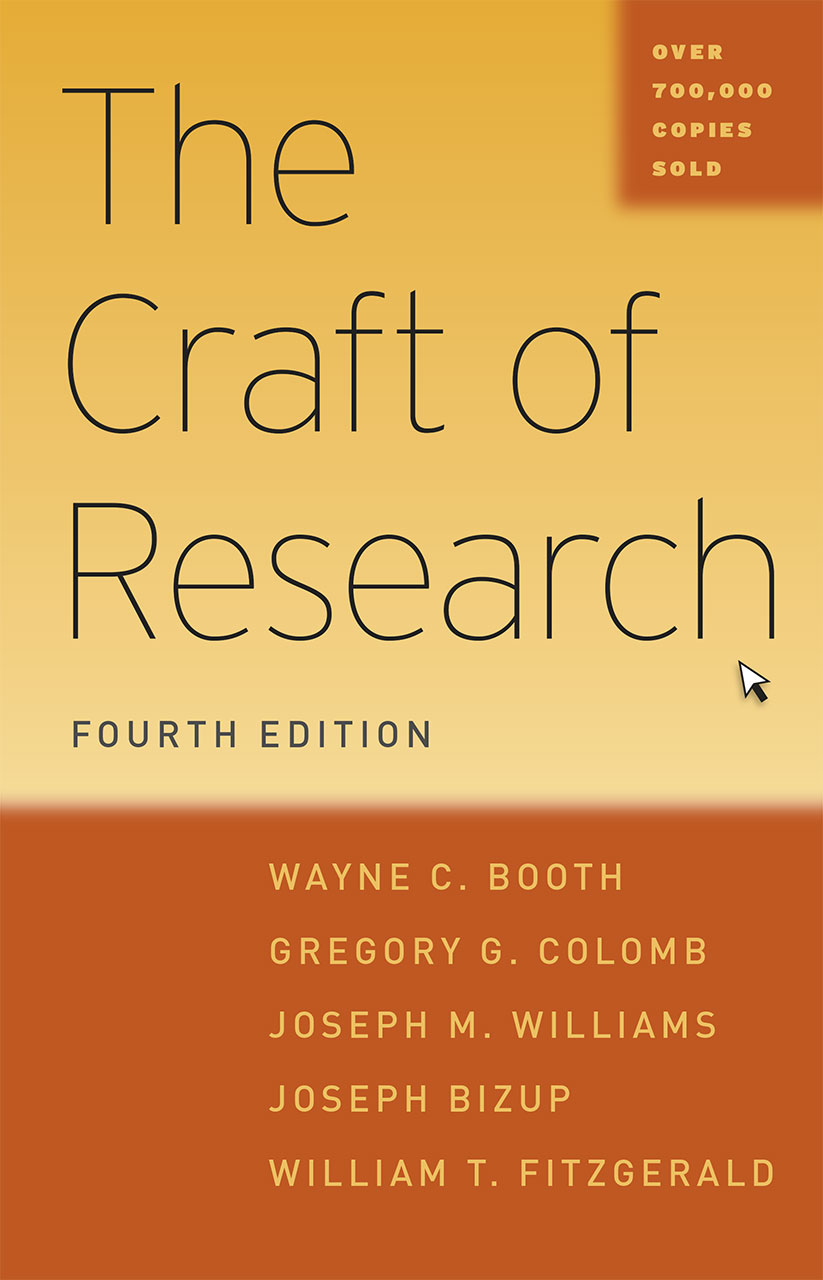
Wayne C. Booth, Gregory G. Colomb, and Joseph M. Williams address this challenge in The Craft of Research, a book that has remained a valuable guide for students and researchers across disciplines. Its appeal lies partly in its accessibility, but its more enduring contribution is the way it connects the practical tasks of research with the intellectual responsibilities that accompany them.
One of the book's most useful propositions is that research should move beyond identifying a topic to formulating a question and establishing its significance. The authors offer a simple framework. What am I studying? What do I want to find out about it? Why should the answer matter to my readers?
The simplicity of this formulation should not obscure its importance.
A topic gives us a field of interest, but it does not, by itself, provide a direction for inquiry. A question begins to establish that direction by identifying something we do not yet understand. The question of significance takes the inquiry further, requiring us to explain why the answer deserves attention. What might it help us understand that we could not adequately explain before?
This movement from topic to question and significance is among the most valuable lessons the book offers. It asks researchers to reconsider the relationship between what interests them and what they hope their work will contribute. An intellectually engaging subject does not automatically produce a meaningful research project. The researcher must identify a problem worth investigating and demonstrate how the investigation might advance understanding.
Consider, for instance, the study of Partition in Indian cinema. The subject is vast, encompassing historical events, individual experiences, national narratives, gendered representations, and competing memories of displacement. A research project becomes more focused when it asks how selected films represent the relationship between displacement and national belonging. It becomes more consequential when it explains what those representations might reveal about the construction of collective memory or the exclusions embedded in national histories.
The subject has not changed, but the nature of the inquiry has. The researcher has moved from an extensive field of interest towards a question that can guide interpretation and a contribution that can be examined through evidence.
This is where The Craft of Research becomes particularly useful. Its emphasis on questions, evidence, arguments, and readers reminds us that these elements cannot be treated as separate components of scholarly work. The question determines, in part, what evidence we seek. The evidence places limits on the claims we can reasonably make. The argument must establish how those claims respond to the original problem, while the intended readership helps us determine what requires explanation and why.
Research, in this understanding, is not simply about assembling material and presenting the results. It involves making judgements, establishing relationships, testing interpretations, and accepting the responsibility of supporting one's claims.
The book's attention to readers is especially significant. Researchers can become so absorbed in the material they have collected that they lose sight of the question that brought them to it. A wealth of information may produce an extensive account without necessarily yielding a clear argument. Asking what readers stand to gain from an investigation helps restore a sense of direction. It requires the researcher to explain not only what has been discovered but also what the discovery makes possible in terms of further understanding.
There is, however, a qualification worth keeping in mind. The framework is best understood as a set of intellectual resources rather than a formula that every research project must follow in precisely the same way. In historical, interpretive, ethnographic, and other forms of qualitative inquiry, questions may change as the researcher encounters new evidence or recognises limitations in the assumptions with which the investigation began. Archives may be incomplete, testimonies may conflict, and the categories through which evidence is interpreted may themselves require critical examination.
These difficulties are particularly important when research concerns histories of colonialism, social inequality, cultural representation, or the production of knowledge itself. In such instances, the researcher may need to examine not only the available evidence but also the historical circumstances in which that evidence was produced, preserved, classified, or excluded. The question is no longer simply what the sources tell us, but also what their silences and limitations permit us to claim.
This does not diminish the value of the approach developed in The Craft of Research. Rather, it reminds us that the craft requires judgement as well as method. A framework can help organise inquiry, but it cannot substitute for the intellectual work of determining what a particular problem demands.
Perhaps this is the book's most enduring lesson. Good research begins with curiosity, but curiosity alone is insufficient. It must develop into a question, encounter evidence, take the form of an argument, and establish why the resulting understanding matters. The researcher must remain attentive to the difference between information and explanation, between a plausible interpretation and a substantiated claim, and between describing a subject and contributing to the ways in which it is understood.
The Craft of Research is valuable because it brings these responsibilities into focus without making research appear inaccessible to those beginning their intellectual journeys. It offers practical guidance, but its larger invitation is to approach research as a disciplined form of inquiry—one that requires clarity of purpose, openness to evidence, and a willingness to justify one's conclusions.
Ultimately, the quality of research depends not only on how much we know about a subject but also on the questions we learn to ask of it. And perhaps the more difficult question, one that every researcher must eventually confront, is this: having investigated a subject and arrived at an answer, what have we helped others understand that they could not adequately understand before?

